思考的乐趣第二季第009课:群论初探
课程导引 / Overview
上节课我们学会了模运算的基本概念和性质。
这节课我们要盯着运算表看,发现一个统一的深层结构:群(group)。
群是代数学中最核心的概念之一,它把封闭性、结合律、单位元、逆元四条最本质的运算性质抽象出来,
统一描述了从数字加法、时钟旋转到魔方变换等各种不同的"运算系统"。
In the last lesson, we learned modular arithmetic and its properties. Today we will stare at operation tables and discover a unifying structure: the group. A group abstracts the four fundamental properties of an operation — closure, associativity, identity, and inverse — and provides a unified framework to describe various "systems of operations", from addition of numbers to rotations of a clock to transformations of a Rubik's cube.
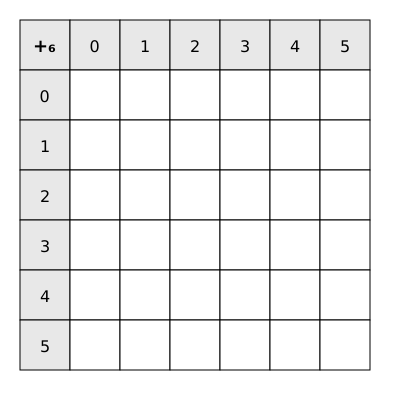
Q1: 完成 mod \(6\) 加法表 / Complete the mod \(6\) Addition Table
难度:★☆☆☆☆
在 mod \(6\) 的世界里只有六个数字:\(\{0, 1, 2, 3, 4, 5\}\)。
请完成下面的加法表——每一格填 \(a + b\) 除以 \(6\) 的余数。这种加法也可以用 \(a +_6 b\) 来表示,读作"模 \(6\) 的加法"。
In the world of mod 6, there are only six numbers: \(\{0,1,2,3,4,5\}\).
Fill in each cell with \(a +_6 b\), the remainder of \(a+b\) divided by 6.
答案与解析 / Answer
\[\begin{array}{c|cccccc}
+_6 & 0 & 1 & 2 & 3 & 4 & 5 \\ \hline
0 & 0 & 1 & 2 & 3 & 4 & 5 \\
1 & 1 & 2 & 3 & 4 & 5 & 0 \\
2 & 2 & 3 & 4 & 5 & 0 & 1 \\
3 & 3 & 4 & 5 & 0 & 1 & 2 \\
4 & 4 & 5 & 0 & 1 & 2 & 3 \\
5 & 5 & 0 & 1 & 2 & 3 & 4
\end{array}\]
规律:每一行都是 \(\{0,1,2,3,4,5\}\) 的一个循环排列,整张表关于主对角线对称(因为加法满足交换律)。
Pattern: each row is a cyclic shift of \(\{0,1,2,3,4,5\}\), and the table is symmetric about the main
diagonal (addition is commutative).
Q2: 从运算表中发现规律 / Discovering Patterns in the Table
难度:★★☆☆☆
仔细观察你刚填好的 mod \(6\) 加法表,回答以下四个问题:
- 封闭性:表格里的数字有没有超出 \(\{0,1,2,3,4,5\}\) 的范围?
- 单位元:哪个数字"加了等于没加"?也就是说,哪个数 \(e\) 满足对所有 \(a\),\(a +_6 e = a\)?
- 逆元:每个数字能不能找到一个"搭档",使得它们的模 \(6\) 之和为 \(0\)?
例如 \(2\) 的搭档是谁?\(5\) 的搭档是谁?
- 结合律:验证 \((2 +_6 3) +_6 4\) 和 \(2 +_6 (3 +_6 4)\) 的结果是否相同。
Examine the table and answer: (a) Are all entries within \(\{0,\ldots,5\}\)? (Closure)
(b) Which element acts as an identity? (c) Does every element have an inverse?
(d) Is addition associative?
答案与解析 / Answer
- 封闭性:是的,表格中所有数字都在 \(\{0,1,2,3,4,5\}\) 中,没有超出范围。
- 单位元:\(e = 0\)。\(0\) 所在的行和列与表头完全相同,说明 \(a +_6 0 = 0 +_6 a = a\)。
- 逆元:每个元素都有搭档——\(0 \leftrightarrow 0\),\(1 \leftrightarrow 5\),\(2 \leftrightarrow
4\),\(3 \leftrightarrow 3\)。通式:\(a\) 的逆元是 \(6 - a \pmod{6}\)。
- 结合律:\((2 +_6 3) +_6 4 = 5 +_6 4 = 3\);\(2 +_6 (3 +_6 4) = 2 +_6 1 = 3\)。结果相同。✓
(a) Closure: Yes — all entries are within \(\{0,\ldots,5\}\).
(b) Identity: \(e = 0\).
(c) Inverses: \(0 \leftrightarrow 0\), \(1 \leftrightarrow 5\), \(2 \leftrightarrow 4\),
\(3 \leftrightarrow 3\). In general, the inverse of \(a\) is \(6 - a \pmod{6}\).
(d) Associativity: \((2+_63)+_64 = 5+_64 = 3\) and \(2+_6(3+_64) = 2+_61 = 3\). Equal. ✓
群的定义 / Definition of a Group
Q2 中你发现的四条性质正是数学家所说的群(group)的四条公理。
一个集合 \(G\) 配上一个运算 \(\cdot\),记为 \((G, \cdot)\),如果满足:
- 封闭性(Closure):对任意 \(a, b \in G\),\(a \cdot b \in G\)。
- 结合律(Associativity):对任意 \(a, b, c \in G\),\((a \cdot b) \cdot c = a \cdot (b \cdot c)\)。
- 单位元(Identity):存在元素 \(e \in G\),使得对所有 \(a \in G\),\(a \cdot e = e \cdot a = a\)。
- 逆元(Inverse):对每个 \(a \in G\),存在 \(a^{-1} \in G\),使得 \(a \cdot a^{-1} = a^{-1} \cdot a =
e\)。
我们刚才验证了 \((\{0,1,2,3,4,5\}, +_6)\) 满足这四条——它就是群!
我们把它记为 \(\mathbb{Z}_6\),叫做整数模 \(6\) 加法群。
其实我们早就见过群了。全体整数 \(\mathbb{Z} = \{\ldots, -2, -1, 0, 1, 2, \ldots\}\)
在普通加法下也构成一个群:
封闭性(两个整数相加还是整数)、结合律、单位元(\(0\))、逆元(\(n\) 的逆元是 \(-n\))——四条全部满足。
\((\mathbb{Z}, +)\) 是一个我们熟悉得不能再熟悉的群,只是以前没有用"群"这个名字叫它。
注意它有无穷多个元素——群的大小没有上限。
一个群 \(G\) 中元素的个数叫做群的阶(order),记为 \(|G|\)。
\(\mathbb{Z}_6\) 有 \(6\) 个元素,所以 \(|\mathbb{Z}_6| = 6\),是一个\(6\) 阶群;
而 \((\mathbb{Z}, +)\) 的阶是无穷大。
群的阶是描述群"大小"的最基本量——后面我们会看到,
群的阶与它的子群、同态等性质有着深刻的联系。
The four properties you found — closure, associativity, identity, and inverse —
are exactly the axioms of a group.
\((\{0,1,2,3,4,5\}, +_6)\) is a group, denoted \(\mathbb{Z}_6\).
In fact, we have seen a group long before today: the integers \((\mathbb{Z}, +)\) form a group
under ordinary addition — closure, associativity, identity \(0\), and inverse \(-n\) all hold.
It just has infinitely many elements. There is no upper bound on the size of a group.
The number of elements is called the group's order \(|G|\);
\(|\mathbb{Z}_6| = 6\), while \(|(\mathbb{Z},+)| = \infty\).
Q3: 完成 mod \(5\) 乘法表 / Complete the mod \(5\) Multiplication Table
难度:★☆☆☆☆
现在换一个运算:乘法。用元素 \(\{1, 2, 3, 4\}\)(注意不包含 \(0\)),
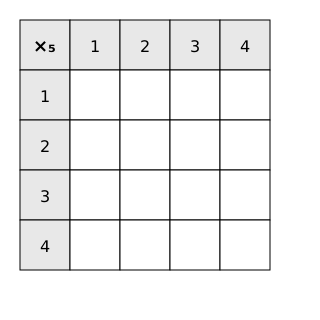
完成 mod \(5\) 乘法表。每一格填 \(a \times b\) 除以 \(5\) 的余数。
Now switch to multiplication. Using elements \(\{1,2,3,4\}\) (excluding 0),
fill in the mod 5 multiplication table.
答案与解析 / Answer
\[\begin{array}{c|cccc}
\times_5 & 1 & 2 & 3 & 4 \\ \hline
1 & 1 & 2 & 3 & 4 \\
2 & 2 & 4 & 1 & 3 \\
3 & 3 & 1 & 4 & 2 \\
4 & 4 & 3 & 2 & 1
\end{array}\]
注意:表格中每一行、每一列都恰好是 \(\{1,2,3,4\}\) 的一个排列(拉丁方),并且关于对角线对称(乘法满足交换律)。
Note: every row and column is a permutation of \(\{1,2,3,4\}\) (a Latin square), and the table is symmetric
(multiplication is commutative).
Q4: \(\{1,2,3,4\}\) 在 mod \(5\) 乘法下是群吗?/ Is \(\{1,2,3,4\}\) a Group under mod \(5\) Multiplication?
难度:★★☆☆☆
对照群的四条公理,逐条验证 \((\{1,2,3,4\}, \times_5)\):
- 封闭性:所有乘积的结果都在 \(\{1,2,3,4\}\) 中吗?
- 哪个元素是单位元?
- 每个元素的逆元是谁?(提示:在乘法表中找乘积为 \(1\) 的配对。)
- 结合律成立吗?(乘法天然满足结合律。)
Verify the four group axioms for \((\{1,2,3,4\}, \times_5)\).
答案与解析 / Answer
- 封闭性:是的,所有乘积都在 \(\{1,2,3,4\}\) 中。
- 单位元:\(e = 1\)。\(1\) 所在的行和列与表头完全相同。
- 逆元:\(1^{-1} = 1\),\(2^{-1} = 3\)(因为 \(2 \times_5 3 = 6 \equiv 1\)),\(3^{-1} =
2\),\(4^{-1} = 4\)(因为 \(4 \times_5 4 = 16 \equiv 1\))。
- 结合律:整数乘法天然满足结合律,取模不影响。✓
结论:\((\{1,2,3,4\}, \times_5)\) 是群!这就是 \(\mathbb{Z}_5^*\)。
(a) Closure: ✓ (b) Identity: \(e = 1\). (c) Inverses: \(1^{-1}=1\), \(2^{-1}=3\), \(3^{-1}=2\),
\(4^{-1}=4\). (d) Associativity: ✓ (inherited from integer multiplication). Conclusion: it is a group —
\(\mathbb{Z}_5^*\).
Q5: \(\{1,2,3,4,5\}\) 在 mod \(6\) 乘法下是群吗?/ Does \(\{1,2,3,4,5\}\) form a Group under mod \(6\)
Multiplication?
难度:★★☆☆☆
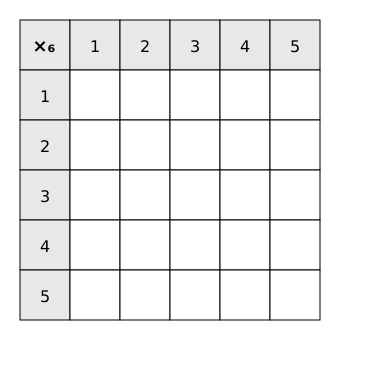
用元素 \(\{1, 2, 3, 4, 5\}\),完成 mod \(6\) 乘法表。
然后检查:这张表满足群的四条公理吗?
提示:仔细看 \(2 \times_6 3\) 等于多少——它还在 \(\{1,2,3,4,5\}\) 中吗?
哪些元素找不到逆元?
Fill in the mod 6 multiplication table for \(\{1,2,3,4,5\}\). Does it satisfy all four group axioms?
Hint: what is \(2 \times_6 3\)?
答案与解析 / Answer
\[\begin{array}{c|ccccc}
\times_6 & 1 & 2 & 3 & 4 & 5 \\ \hline
1 & 1 & 2 & 3 & 4 & 5 \\
2 & 2 & 4 & 0 & 2 & 4 \\
3 & 3 & 0 & 3 & 0 & 3 \\
4 & 4 & 2 & 0 & 4 & 2 \\
5 & 5 & 4 & 3 & 2 & 1
\end{array}\]
不是群。封闭性就已经被破坏:\(2 \times_6 3 = 6 \equiv 0\),而 \(0 \notin \{1,2,3,4,5\}\)。
此外,元素 \(2, 3, 4\) 找不到逆元——它们所在的行中没有 \(1\) 出现。
Not a group. Closure fails: \(2 \times_6 3 = 0 \notin \{1,2,3,4,5\}\).
Moreover, elements \(2, 3, 4\) have no inverse — the value \(1\) never appears in their rows.
Q6: 找到最大的"好"子集 / Finding the Largest "Good" Subset
难度:★★★☆☆
从 \(\{1,2,3,4,5\}\) 中挑出一个最大的子集,使得它在 mod \(6\) 乘法下构成群。
这些数字有什么共同特征?
提示:哪些数字不会制造出"麻烦"(即不会出现乘积为 \(0\) 的情况)?
用一个词概括这些数字和 \(6\) 的关系。
Find the largest subset of \(\{1,2,3,4,5\}\) that forms a group under mod 6 multiplication.
What do these numbers have in common with respect to 6?
答案与解析 / Answer
最大的好子集是 \(\{1, 5\}\)。
\[\begin{array}{c|cc}
\times_6 & 1 & 5 \\ \hline
1 & 1 & 5 \\
5 & 5 & 1
\end{array}\]
验证:封闭 ✓、\(e = 1\) ✓、\(1^{-1} = 1\),\(5^{-1} = 5\) ✓,满足群的四条公理。
共同特征:\(1\) 和 \(5\) 都与 \(6\) 互素(最大公因数为 \(1\))。
而 \(2, 3, 4\) 与 \(6\) 有公因子,所以它们的乘积可能产生 \(0\)(零因子)。
这个子集就是 \(\mathbb{Z}_6^* = \{1, 5\}\),群的阶为 \(\varphi(6) = 2\)。
The largest subset is \(\{1, 5\}\) — exactly the elements coprime to \(6\).
Elements \(2, 3, 4\) share a common factor with \(6\), producing zero divisors.
This is \(\mathbb{Z}_6^*\), with order \(\varphi(6) = 2\).
两族经典的群 / Two Families of Classical Groups
通过 Q1–Q6 的探索,我们发现了两个重要的群族:
- 整数模 \(n\) 加法群 \(\mathbb{Z}_n = (\{0, 1, \ldots, n-1\}, +_n)\),
群的阶(元素个数)为 \(n\)。
- 整数模 \(n\) 乘法群 \(\mathbb{Z}_n^* = (\{\text{与 } n \text{ 互素的数}\}, \times_n)\),
群的阶为 \(\varphi(n)\)(欧拉函数)。
Q5 告诉我们,并非所有集合配运算都能构成群——关键在于逆元的存在性。
对于模 \(n\) 乘法,只有与 \(n\) 互素的数才有逆元。
Two main families: additive group \(\mathbb{Z}_n\) of order \(n\),
and multiplicative group \(\mathbb{Z}_n^*\) of order \(\varphi(n)\)
(only elements coprime to \(n\) have inverses under multiplication).
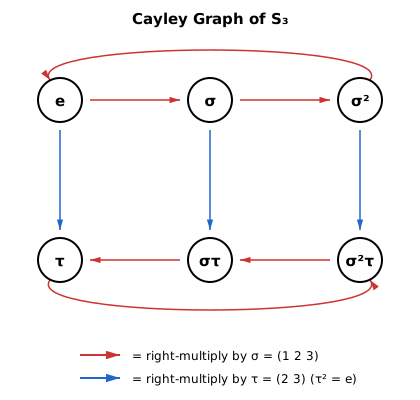
凯莱图 / Cayley Graph
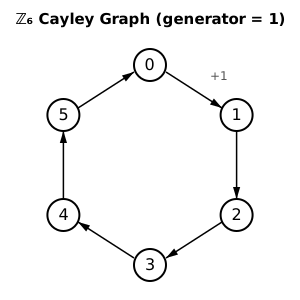
运算表虽然完整,但很难"一眼看出"群的结构。凯莱图(Cayley graph)让我们把群"画"出来:
- 每个群元素画成一个节点(圆圈)。
- 选定一个生成元 \(g\):对每个元素 \(a\),画一条从 \(a\) 到 \(a \cdot g\) 的箭头。
- 沿着箭头走,就是不断执行群运算。
什么是生成元?/ What Is a Generator?
"生成元"这个名字听起来很神秘,其实很直观:
如果从单位元 \(e\) 出发,把 \(g\) 一次次地叠加上去,
最终能走遍群里的每一个元素,那么 \(g\) 就是一个生成元。
以 \(\mathbb{Z}_6\) 为例,试试从 \(0\) 出发,每次 \(+1\):
\[0 \xrightarrow{+1} 1 \xrightarrow{+1} 2 \xrightarrow{+1} 3 \xrightarrow{+1} 4 \xrightarrow{+1} 5
\xrightarrow{+1} 0\]
六步走完,\(0,1,2,3,4,5\) 全部经过,最后回到原点——所以 \(1\) 是 \(\mathbb{Z}_6\) 的一个生成元。
但不是每个元素都是生成元。试试从 \(0\) 出发,每次 \(+2\):
\[0 \xrightarrow{+2} 2 \xrightarrow{+2} 4 \xrightarrow{+2} 0 \xrightarrow{+2} \cdots\]
只能走到 \(\{0, 2, 4\}\),永远到不了 \(1, 3, 5\)——所以 \(2\) 不是 \(\mathbb{Z}_6\) 的生成元。
(它只能"生成"群里的一个更小的子集。)
A generator \(g\) is an element that can reach every other element by repeated application:
\(e,\ g,\ g^2,\ g^3,\ \ldots\) eventually visits the whole group.
In \(\mathbb{Z}_6\), element \(1\) is a generator (six steps cover all six elements),
but element \(2\) is not (it only cycles through \(\{0,2,4\}\)).
Q7: 画 \(\mathbb{Z}_6\) 的凯莱图 / Draw the Cayley Graph of \(\mathbb{Z}_6\)
难度:★★☆☆☆
以 \(1\) 为生成元,画出 \(\mathbb{Z}_6\) 加法群的凯莱图。
从 \(0\) 出发,每次 \(+1\),画出所有箭头。你看到了什么形状?
Using generator 1, draw the Cayley graph of \(\mathbb{Z}_6\).
Starting from 0, draw an arrow from each element to the next (\(+1\)).
What shape do you see?
答案与解析 / Answer
以生成元 \(1\) 出发,箭头为 \(0 \to 1 \to 2 \to 3 \to 4 \to 5 \to 0\)。
图形是一个正六边形(\(6\)-环),\(6\) 个节点首尾相接形成闭环。
Starting from generator \(1\): \(0 \to 1 \to 2 \to 3 \to 4 \to 5 \to 0\).
The shape is a regular hexagon (a 6-cycle).
Q8: 画 \(\mathbb{Z}_5^*\) 的凯莱图 / Draw the Cayley Graph of \(\mathbb{Z}_5^*\)
难度:★★☆☆☆
以 \(2\) 为生成元,画出 \(\mathbb{Z}_5^*\) 乘法群的凯莱图。
从 \(1\) 出发,不断乘以 \(2\)(mod \(5\)):\(1 \to 2 \to 4 \to 3 \to 1\)。
你看到了什么形状?
With generator 2, draw the Cayley graph of \(\mathbb{Z}_5^*\):
\(1 \to 2 \to 4 \to 3 \to 1\). What shape is it?
答案与解析 / Answer
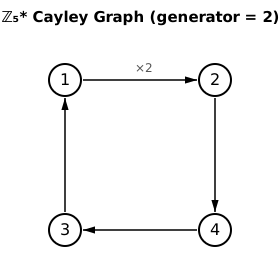
以生成元 \(2\) 出发:\(1 \xrightarrow{\times 2} 2 \xrightarrow{\times 2} 4 \xrightarrow{\times 2} 3
\xrightarrow{\times 2} 1\)。
图形是一个正方形(\(4\)-环),\(4\) 个节点首尾相接。
With generator \(2\): \(1 \to 2 \to 4 \to 3 \to 1\). The shape is a square (a 4-cycle).
Q9: 两个群,同一张图?/ Two Groups, Same Graph?
难度:★★★☆☆
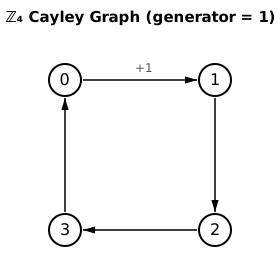
画出 \(\mathbb{Z}_4\) 加法群(生成元 \(1\))的凯莱图:\(0 \to 1 \to 2 \to 3 \to 0\)。
把它和 Q8 中 \(\mathbb{Z}_5^*\) 的凯莱图放在一起。这两张图长得一样吗?
一个是加法群、一个是乘法群,元素完全不同,但凯莱图的"形状"相同——
这意味着什么?
Draw the Cayley graph of \(\mathbb{Z}_4\) (generator 1) and compare it with \(\mathbb{Z}_5^*\) from Q8.
They look the same! What does this mean?
答案与解析 / Answer
\(\mathbb{Z}_4\) 的凯莱图:\(0 \to 1 \to 2 \to 3 \to 0\),也是一个 \(4\)-环。
两张图的形状完全相同——都是 \(4\) 个节点的有向环。
一个是加法群(\(\mathbb{Z}_4\)),一个是乘法群(\(\mathbb{Z}_5^*\)),元素和运算都不同,
但它们的“结构”本质上一样。这种“结构相同”的精确说法就是群同构(isomorphism):
\(\mathbb{Z}_4 \cong \mathbb{Z}_5^*\)。
Both graphs are identical 4-cycles. Despite different elements and operations,
\(\mathbb{Z}_4\) and \(\mathbb{Z}_5^*\) have the same structure — they are isomorphic:
\(\mathbb{Z}_4 \cong \mathbb{Z}_5^*\).
置换的概念 / The Concept of Permutations
到目前为止,我们的群元素都是数字。但群的力量在于——
群的元素可以是任何东西,只要满足四条公理。
置换(permutation)= 把 \(n\) 个元素重新排列的方式。
定义两个置换 \(\sigma\) 和 \(\tau\),它们将在后面的多道题目中反复出现:
\[\sigma = \begin{pmatrix} 1 & 2 & 3 \\ 2 & 3 & 1 \end{pmatrix}, \qquad
\tau = \begin{pmatrix} 1 & 2 & 3 \\ 1 & 3 & 2 \end{pmatrix}\]
- \(\sigma\) 把 \(1 \to 2\),\(2 \to 3\),\(3 \to 1\)——三个元素"轮转"了一圈。
- \(\tau\) 把 \(1 \to 1\)(不动),\(2 \to 3\),\(3 \to 2\)——只交换了后两个元素。
我们用"两行记法"表示一个置换:上面一行是原来的位置,下面一行是新的位置。
还有一种更简洁的写法叫循环记法(cycle notation):
把"一圈轮转"的元素写在括号里——例如 \(1 \to 2 \to 3 \to 1\) 写作 \((1\,2\,3)\),
只交换两个元素 \(2 \leftrightarrow 3\)(\(1\) 不动)写作 \((2\,3)\)。
A permutation rearranges \(n\) objects. Two-line notation shows original positions on top,
new positions on the bottom. Cycle notation is a shorthand: \((1\,2\,3)\) means
\(1\to2\to3\to1\);
\((2\,3)\) means swap \(2\) and \(3\), leaving \(1\) fixed.
We define two permutations that will appear throughout this section:
- \(\sigma\): \(1 \to 2 \to 3 \to 1\) (a cyclic rotation of all three elements).
- \(\tau\): swaps \(2\) and \(3\), leaving \(1\) fixed.
Q10: 置换的复合 / Composition of Permutations
难度:★★☆☆☆
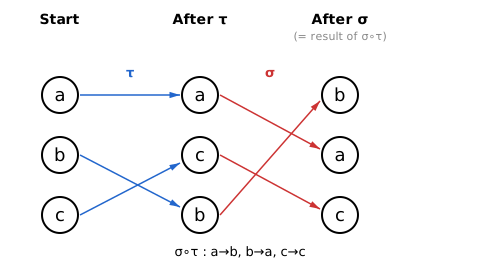
置换的"乘法"就是复合:先做一次重排,再做一次重排。注意三件事:
-
我们在"操作""操作":置换本身就是一种操作(把元素重排),
而复合是把两个操作合并成一个新操作——我们操作的对象已经不是数字,而是"操作"本身。
-
先做右边:\(\sigma \circ \tau\) 的读法是"先做 \(\tau\),再做 \(\sigma\)"。
符号顺序与执行顺序相反——这和函数复合的写法 \(f(g(x))\) 一致:先算里面的 \(g\),再算外面的 \(f\)。
-
符号 \(\circ\) = 复合:读作"复合"或"接着做"。
\(\sigma \circ \tau\) 就是"先做 \(\tau\),再把结果交给 \(\sigma\) 处理"。
Composition means "do one permutation, then the other." Three things to note:
(1) we are now operating on operations;
(2) in \(\sigma \circ \tau\), apply \(\tau\) first (right-to-left order, just like \(f(g(x))\));
(3) the symbol \(\circ\) means "compose" / "follow by".
用前面定义的 \(\sigma\) 和 \(\tau\),
分别计算 \(\sigma \circ \tau\)(先做 \(\tau\) 再做 \(\sigma\))和 \(\tau \circ \sigma\)(先做 \(\sigma\) 再做 \(\tau\))。
关键问题:\(\sigma \circ \tau\) 和 \(\tau \circ \sigma\) 的结果一样吗?
Compute \(\sigma \circ \tau\) and \(\tau \circ \sigma\). Are they equal?
答案与解析 / Answer
\(\sigma \circ \tau\)(先做 \(\tau\) 再做 \(\sigma\)):
\[\sigma \circ \tau: \quad 1 \xrightarrow{\tau} 1 \xrightarrow{\sigma} 2, \quad
2 \xrightarrow{\tau} 3 \xrightarrow{\sigma} 1, \quad
3 \xrightarrow{\tau} 2 \xrightarrow{\sigma} 3
\quad \Longrightarrow \quad \sigma\tau = (1\,2)\]
\(\tau \circ \sigma\)(先做 \(\sigma\) 再做 \(\tau\)):
\[\tau \circ \sigma: \quad 1 \xrightarrow{\sigma} 2 \xrightarrow{\tau} 3, \quad
2 \xrightarrow{\sigma} 3 \xrightarrow{\tau} 2, \quad
3 \xrightarrow{\sigma} 1 \xrightarrow{\tau} 1
\quad \Longrightarrow \quad \tau\sigma = (1\,3)\]
\(\sigma\tau = (1\,2) \neq (1\,3) = \tau\sigma\)。
两个结果不同!置换的复合不满足交换律。
\(\sigma\tau = (1\,2) \neq (1\,3) = \tau\sigma\). Composition of permutations is not
commutative.
Q11: 列出 \(\{1,2,3\}\) 的全部置换 / List All Permutations of \(\{1,2,3\}\)
难度:★★☆☆☆
写出 \(\{1,2,3\}\) 的所有可能的重排方式。一共有几个?
提示:第一个位置有 \(3\) 种选择,第二个位置有 \(2\) 种……
List every possible rearrangement of \(\{1,2,3\}\). How many are there?
答案与解析 / Answer
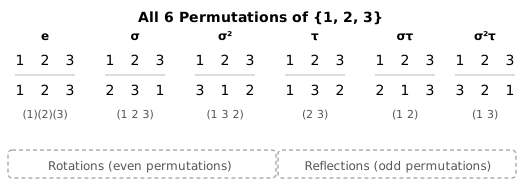
共 \(3! = 6\) 个置换。用两行记法和循环记法分别写出:
\[\begin{aligned}
e &= \begin{pmatrix} 1 & 2 & 3 \\ 1 & 2 & 3 \end{pmatrix} = \text{id} &\quad
\sigma &= \begin{pmatrix} 1 & 2 & 3 \\ 2 & 3 & 1 \end{pmatrix} = (1\,2\,3) \\[4pt]
\sigma^2 &= \begin{pmatrix} 1 & 2 & 3 \\ 3 & 1 & 2 \end{pmatrix} = (1\,3\,2) &\quad
\tau &= \begin{pmatrix} 1 & 2 & 3 \\ 1 & 3 & 2 \end{pmatrix} = (2\,3) \\[4pt]
\sigma\tau &= \begin{pmatrix} 1 & 2 & 3 \\ 2 & 1 & 3 \end{pmatrix} = (1\,2) &\quad
\sigma^2\tau &= \begin{pmatrix} 1 & 2 & 3 \\ 3 & 2 & 1 \end{pmatrix} = (1\,3)
\end{aligned}\]
其中 \(e, \sigma, \sigma^2\) 是三个旋转,\(\tau, \sigma\tau, \sigma^2\tau\) 是三个对换(转置)。
There are \(3! = 6\) permutations: three rotations (\(e, \sigma, \sigma^2\))
and three transpositions (\(\tau, \sigma\tau, \sigma^2\tau\)).
Q12: 验证置换群的公理 / Verifying the Group Axioms for Permutations
难度:★★★☆☆
Q11 中你找到了 \(6\) 个置换。现在验证它们在复合运算下满足群的四条公理:
- 封闭性:两次重排的结果还是一次重排吗?(为什么?)
- 单位元:哪个置换"什么都不动"?
- 逆元:每个置换能不能找到一个"反操作"?例如 \(\sigma\)(\(1 \to 2 \to 3 \to 1\))的逆元是什么?
- 结合律:复合运算满足结合律。(想想为什么——考虑对每个元素逐个追踪。)
Verify all four group axioms for the 6 permutations of \(\{1,2,3\}\) under composition.
答案与解析 / Answer
- 封闭性:两次重排的结果仍是一次重排。每个元素都有唯一的去处、唯一的来源,把两次操作合并后这一性质不变。
- 单位元:恒等置换 \(e\)——什么都不动的操作。对任意 \(\pi\),\(e \circ \pi = \pi \circ e = \pi\)。
- 逆元:每个置换都有逆操作——把映射反过来。例如 \(\sigma = (1\,2\,3)\) 的逆元是 \(\sigma^{-1} = \sigma^2 =
(1\,3\,2)\)(因为 \(\sigma^3 = e\));\(\tau = (2\,3)\) 的逆元是 \(\tau\) 自己(因为 \(\tau^2 = e\))。
- 结合律:函数复合天然满足结合律。对任意 \(f, g, h\) 和元素 \(x\),\(((f \circ g) \circ h)(x) = f(g(h(x))) = (f
\circ (g \circ h))(x)\)。
(a) Closure: every permutation maps each element to a unique destination with a unique origin; composing two such operations preserves this property.
(b) Identity: the identity permutation \(e\).
(c) Inverses: reverse each mapping. \(\sigma^{-1} = \sigma^2 = (1\,3\,2)\); \(\tau^{-1} =
\tau\).
(d) Associativity: function composition is always associative.
对称群 \(S_n\) / The Symmetric Group \(S_n\)
\(n\) 个元素的全部置换在复合运算下构成群,叫做 \(n\) 阶对称群,记为 \(S_n\)。
- \(S_n\) 的阶(元素个数):\(|S_n| = n!\)
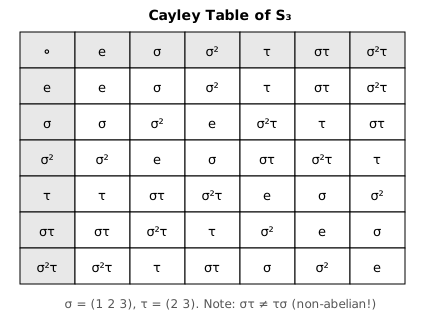
- \(S_3\) 有 \(3! = 6\) 个元素——这是我们遇到的第一个非交换群!
(Q10 已经发现 \(\sigma \circ \tau \neq \tau \circ \sigma\)。)
上面是 \(S_3\) 的完整运算表(Cayley table)。注意它不关于对角线对称——这正是非交换性的体现。
我们也可以画出 \(S_3\) 的凯莱图。选取两个生成元 \(\sigma = (1\,2\,3)\) 和 \(\tau = (2\,3)\):
The full set of permutations of \(n\) elements forms the symmetric group \(S_n\),
with \(|S_n| = n!\). \(S_3\) is our first non-abelian (non-commutative) group.
Q13: \(S_n\) 什么时候是交换群?/ When is \(S_n\) Abelian?
难度:★★☆☆☆
我们知道 \(S_3\) 不是交换群。那么:
- \(S_2\) 是交换群吗?(\(S_2\) 只有 \(2! = 2\) 个元素——写出来看看。)
- \(S_1\) 是交换群吗?
- 对于多大的 \(n\),\(S_n\) 是交换群(阿贝尔群)?对于多大的 \(n\),它不是?
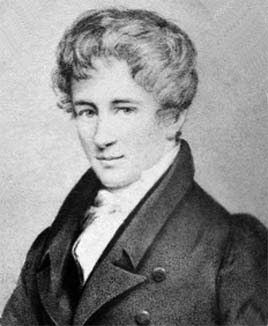
尼尔斯·亨利克·阿贝尔 / Niels Henrik Abel(1802–1829)
For which values of \(n\) is \(S_n\) abelian? For which is it non-abelian?
答案与解析 / Answer
- \(S_2 = \{e, (1\,2)\}\),只有 \(2\) 个元素。\(e \circ (1\,2) = (1\,2) \circ e = (1\,2)\),是交换群。
- \(S_1 = \{e\}\),只有 \(1\) 个元素,当然是交换群。
- \(n \leq 2\) 时 \(S_n\) 是交换群;\(n \geq 3\) 时 \(S_n\) 不是交换群。原因:当 \(n \geq 3\) 时,\(S_n\) 包含
\(S_3\) 作为子群,而 \(S_3\) 已在 Q10 中被证明非交换。
\(S_n\) is abelian for \(n \leq 2\) and non-abelian for \(n \geq 3\)
(since \(S_n\) contains \(S_3\) as a subgroup when \(n \geq 3\), and \(S_3\) is non-abelian by Q10).
群作用 / Group Actions
群不只是抽象的运算表——它可以"作用"在具体的对象上。
- \(\mathbb{Z}_4 = \{0, 1, 2, 3\}\) 可以看成 \(\{0°, 90°, 180°, 270°\}\) 旋转,
作用在正方形上。
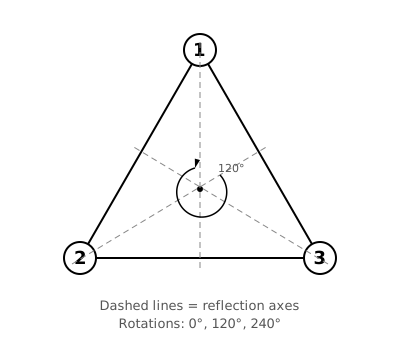
- \(S_3\) 可以作用在等边三角形的三个顶点上——每个置换对应一次旋转或翻转。
群作用(group action)的意思是:同一个抽象的群,可以通过不同的方式"操控"不同的对象。
这是群论最强大的视角之一。
A group action is how a group "moves" concrete objects.
\(\mathbb{Z}_4\) acts on a square via rotations; \(S_3\) acts on a triangle's vertices.
Q14: 等边三角形的对称群 / The Symmetry Group of an Equilateral Triangle
难度:★★★☆☆
一个等边三角形的三个顶点标号为 \(1, 2, 3\)。
- 哪些旋转操作可以保持三角形不变?(有几种?)
- 哪些翻转(以某条对称轴为轴的镜像反射)可以保持三角形不变?(有几种?)
- 把每种操作写成 \(\{1,2,3\}\) 的置换。你得到了几个置换?
- 和 \(S_3\) 的元素对比——你发现了什么?
Which rotations and reflections preserve an equilateral triangle?
Express each as a permutation of its vertices. How does this relate to \(S_3\)?
答案与解析 / Answer
- 旋转共 \(3\) 种:旋转 \(0°\)(不动)、旋转 \(120°\)、旋转 \(240°\)。
- 翻转共 \(3\) 种:分别以过顶点 \(1\)、\(2\)、\(3\) 的对称轴为轴做镜像反射。
- 写成置换:
- 旋转 \(0°\):\(e\)(恒等)
- 旋转 \(120°\):\((1\,2\,3)\)
- 旋转 \(240°\):\((1\,3\,2)\)
- 关于顶点 \(1\) 的轴翻转:\((2\,3)\)
- 关于顶点 \(2\) 的轴翻转:\((1\,3)\)
- 关于顶点 \(3\) 的轴翻转:\((1\,2)\)
- 共 \(6\) 个置换——恰好就是 \(S_3\) 的全部 \(6\) 个元素!等边三角形的对称群就是 \(S_3\)。
3 rotations (\(0°, 120°, 240°\)) + 3 reflections = 6 symmetries.
As permutations: \(\{e,\; (1\,2\,3),\; (1\,3\,2),\; (2\,3),\; (1\,3),\; (1\,2)\}\)
— exactly the 6 elements of \(S_3\). The symmetry group of the equilateral triangle is
\(S_3\).
子群的定义 / Definition of a Subgroup
一个群 \(G\) 的子集 \(H\),如果在同一个运算下也满足群的四条公理,
就叫 \(G\) 的子群(subgroup),记为 \(H \leq G\)。
每个群都有两个"平凡"子群:
- 最小的子群:\(\{e\}\)(只有单位元)
- 最大的子群:\(G\) 自身
那么,有没有"非平凡"的子群呢?
A subgroup \(H \leq G\) is a subset that is itself a group under the same operation.
Every group has the trivial subgroups \(\{e\}\) and \(G\) itself.
Q15: 找出 \(\mathbb{Z}_6\) 的所有子群 / Find All Subgroups of \(\mathbb{Z}_6\)
难度:★★☆☆☆
从 \(\mathbb{Z}_6 = \{0,1,2,3,4,5\}\) 的每个元素出发,反复做 \(+_6\) 加法,
看它生成什么集合。例如:
- 从 \(2\) 出发:\(2, 4, 0, 2, 4, 0, \ldots\) → 生成集合 \(\{0, 2, 4\}\)
对每个元素都这样做,找出 \(\mathbb{Z}_6\) 的所有子群。
Starting from each element, repeatedly apply \(+_6\) to find the generated subgroup.
List all subgroups of \(\mathbb{Z}_6\).
答案与解析 / Answer
从每个元素出发,反复做 \(+_6\):
- \(\langle 0 \rangle = \{0\}\)(阶 \(1\))
- \(\langle 1 \rangle = \{0,1,2,3,4,5\} = \mathbb{Z}_6\)(阶 \(6\))
- \(\langle 2 \rangle = \{0,2,4\}\)(阶 \(3\))
- \(\langle 3 \rangle = \{0,3\}\)(阶 \(2\))
- \(\langle 4 \rangle = \{0,4,2\} = \{0,2,4\}\)(与 \(\langle 2 \rangle\) 相同)
- \(\langle 5 \rangle = \{0,5,4,3,2,1\} = \mathbb{Z}_6\)(与 \(\langle 1 \rangle\) 相同)
去重后,\(\mathbb{Z}_6\) 共有 \(4\) 个子群:
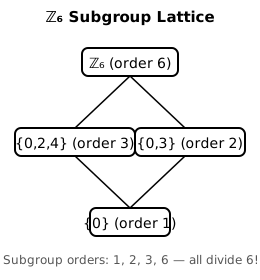
\(\{0\}\)、\(\{0,3\}\)、\(\{0,2,4\}\)、\(\{0,1,2,3,4,5\}\),阶分别为 \(1, 2, 3, 6\)。
After deduplication, \(\mathbb{Z}_6\) has 4 subgroups:
\(\{0\}\), \(\{0,3\}\), \(\{0,2,4\}\), \(\mathbb{Z}_6\), of orders \(1, 2, 3, 6\).
Q16: 发现拉格朗日定理 / Discovering Lagrange's Theorem
难度:★★★☆☆
在 Q15 中,你找到了 \(\mathbb{Z}_6\) 的全部子群。记下每个子群的阶(元素个数)。
- 这些阶分别是多少?
- 它们与 \(6\)(整个群的阶)有什么关系?
- 大胆猜测:这个规律对所有群都成立吗?
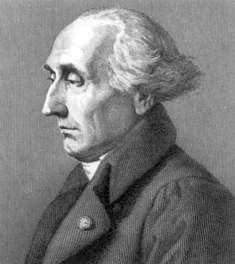
约瑟夫-路易·拉格朗日 / Joseph-Louis Lagrange(1736–1813)
你发现的规律叫做拉格朗日定理(Lagrange's Theorem):
子群的阶一定能整除群的阶。这是群论中最基本也最重要的定理之一。
拉格朗日是法籍意大利裔数学家,他在代数方程、数论、力学和天体力学等领域做出了开创性贡献。
他在研究多项式方程根的置换时,实质上奠定了群论的基础。
拉格朗日定理正是以他的名字命名——这个看似简单的"整除关系",
日后衍生出了费马小定理、欧拉定理等一系列重要推论。
Lagrange was an Italian-French mathematician who made groundbreaking contributions to algebra,
number theory, mechanics, and celestial mechanics. His study of permutations of polynomial roots
essentially laid the foundations of group theory.
Lagrange's Theorem — this seemingly simple "divisibility" relationship — later gives rise to
Fermat's Little Theorem, Euler's Theorem, and many other important corollaries.
Record the orders of all subgroups of \(\mathbb{Z}_6\). What is the pattern?
Your observation is Lagrange's Theorem: the order of any subgroup divides the order of the
group.
答案与解析 / Answer
- 子群的阶分别为 \(1, 2, 3, 6\)。
- 它们都是 \(6\) 的因子:\(6 = 1 \times 6 = 2 \times 3\)。也就是说,每个子群的阶都能整除群的阶。
- 是的!这就是拉格朗日定理:对任意有限群 \(G\) 及其子群 \(H\),\(|H|\) 整除 \(|G|\)。
注意反过来不一定成立——\(|G|\) 的因子 \(n\) 不一定对应一个阶为 \(n\) 的子群。
(a) Orders: \(1, 2, 3, 6\). (b) All divide \(6 = |\mathbb{Z}_6|\).
(c) Yes — this is Lagrange's Theorem: \(|H|\) divides \(|G|\) for any subgroup \(H \leq
G\).
(The converse is not always true — a divisor of \(|G|\) need not correspond to a subgroup.)
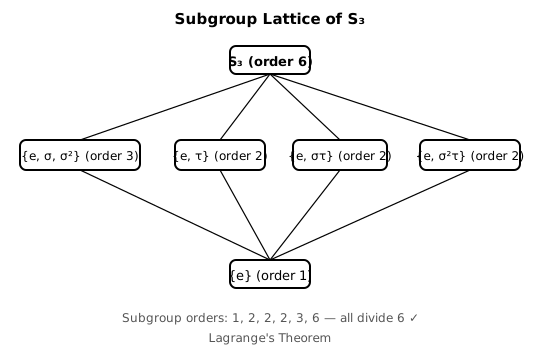
Q17: \(S_3\) 的子群与拉格朗日定理 / Subgroups of \(S_3\) and Lagrange's Theorem
难度:★★★★☆
找出 \(S_3\) 的所有子群。
提示:\(|S_3| = 6\),由拉格朗日定理可知,子群的阶只能是 \(6\) 的因子:\(1, 2, 3, 6\)。
对每种可能的阶,寻找对应的子群。
Find all subgroups of \(S_3\). Hint: by Lagrange's Theorem, possible orders are divisors of 6.
答案与解析 / Answer
\(|S_3| = 6\),由拉格朗日定理,子群的阶只能是 \(6\) 的因子:\(1, 2, 3, 6\)。
- 阶 \(1\):\(\{e\}\)(\(1\) 个子群)
- 阶 \(2\):\(\{e, (1\,2)\}\)、\(\{e, (1\,3)\}\)、\(\{e, (2\,3)\}\)(\(3\) 个子群——每个对换自己生成一个
\(2\) 阶子群)
- 阶 \(3\):\(\{e, (1\,2\,3), (1\,3\,2)\}\)(\(1\) 个子群——由 \(3\)-轮换生成,也叫交替群 \(A_3\))
- 阶 \(6\):\(S_3\) 本身(\(1\) 个子群)
共 \(6\) 个子群。它们的阶 \(1, 2, 2, 2, 3, 6\) 全部整除 \(6\),拉格朗日定理验证通过。✓
\(S_3\) has 6 subgroups: \(\{e\}\); three of order 2 generated by each transposition;
one of order 3: \(\{e,(1\,2\,3),(1\,3\,2)\} = A_3\); and \(S_3\) itself.
All orders (\(1,2,2,2,3,6\)) divide \(6\). Lagrange's Theorem confirmed. ✓
课程总结 / Lesson Summary
本节课我们走过了群论的核心风景:
- 群:满足封闭性、结合律、单位元、逆元四条公理的运算结构。
- 两族经典群:加法群 \(\mathbb{Z}_n\)、乘法群 \(\mathbb{Z}_n^*\)。
- 凯莱图:把群画成有向图,让抽象结构"看得见"。
- 置换群 \(S_n\):群的元素不只是数字——可以是重排方式,\(S_3\) 是第一个非交换群。
- 群作用:用群来描述对称性——三角形的对称群就是 \(S_3\)。
- 子群与拉格朗日定理:群里的群——子群的阶整除群的阶。
不同的群之间有没有联系?如何精确地说"两个群的结构相同"?
这些问题将在课后阅读材料中通过群同态与群同构的概念来回答。
Today we toured the core landscape of group theory: axioms, Cayley tables and graphs,
permutation groups, group actions and symmetry, subgroups and Lagrange's theorem.
How do different groups relate to each other? The concepts of homomorphisms
and isomorphisms await you in the reading material.